Catalog by type of application
Vaporisers



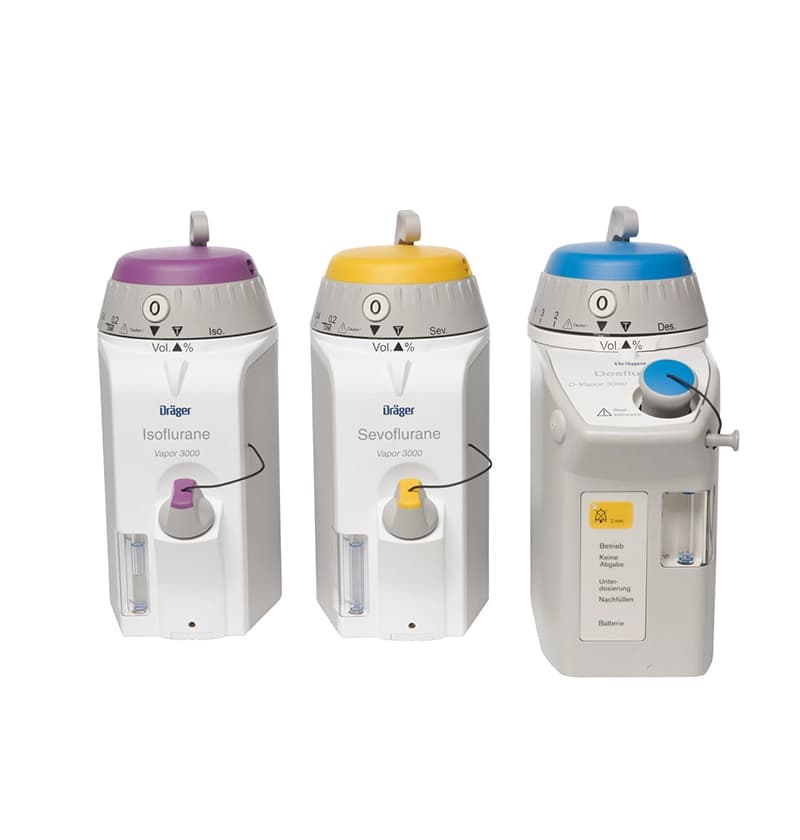
Vaporisers for Anaesthetic Agents Dräger Vapor 3000 and D-Vapor 3000
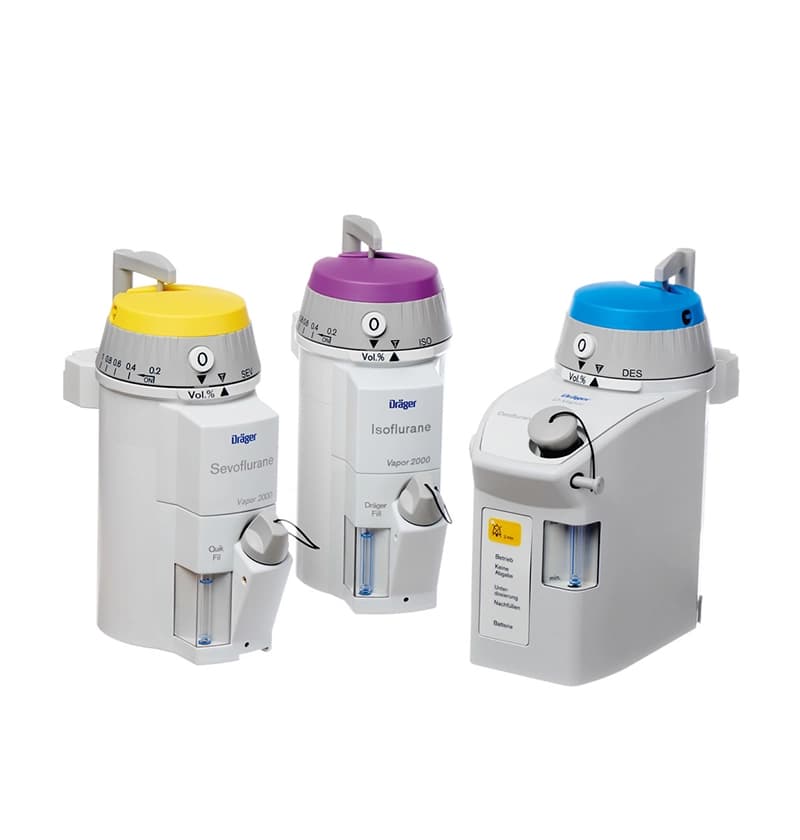
Vaporisers for Anaesthetic Agents Dräger Vapor 2000 and D-Vapor
Evaporators for inhalation anesthesia are used for precise dosing of liquid anesthetics and converting them into vapor, which is delivered into the patient’s breathing mixture. Stability of anesthetic delivery is critical during surgical procedures, as it ensures a predictable depth of anesthesia and controlled anesthetic management. Evaporators integrate with anesthesia machines and anesthesia workstations, allowing the physician to maintain a safe concentration of the agent regardless of changes in gas flow rate or ambient temperature.
Medical evaporators are used during inhalation anesthesia to administer volatile anesthetics such as sevoflurane, isoflurane, or desflurane. Their function is to ensure stable and uniform evaporation of the agent with its transition into a gaseous state and accurate dosing into the gas flow. Anesthetic evaporators are used in operating rooms, surgical centers, intensive care units, and anesthesia departments. They ensure result repeatability, allowing the physician to quickly respond to physiological changes in the patient during surgery.
High dosing accuracy helps minimize the risk of both insufficient and excessive anesthesia. This predictability is essential for safety in inhalation anesthesia, as the patient’s body may respond differently to anesthetic agents depending on age, body weight, general health condition, and duration of the intervention.
Evaporators operate on the principle of controlled evaporation: the liquid anesthetic is stored in a reservoir, where it gradually transitions into a vapor phase. The special design of the evaporation chamber and the temperature compensation system ensure stability of agent concentration. This is important because temperature affects evaporation rate, and uncontrolled changes could lead to unwanted fluctuations in anesthesia depth.
Anesthetic vapor is mixed with the gas mixture (oxygen, air, nitrous oxide) supplied through the anesthesia machine. The concentration delivered to the patient is then controlled by a dosing regulator. Additional locking mechanisms prevent accidental filling of the evaporator with a different anesthetic agent, ensuring safety for both equipment and patient.
Dräger Vapor anesthetic evaporators are used as part of anesthesia workstations to maintain controlled concentrations of inhaled anesthetics. Vapor 2000 / D-Vapor and Vapor 3000 / D-Vapor 3000 models include temperature compensation mechanisms that maintain stable parameters even when gas flow rate changes. They are compatible with various clinical environments and support both standard and low-flow anesthesia modes. The construction of each evaporator includes safety mechanisms that reduce the risk of cross-contamination and prevent incorrect filling.
Using Dräger evaporators provides predictable anesthesia parameters, which is especially important during long procedures or in patients with complex physiological profiles. This ensures high-quality control of the patient’s condition and reduces the risks of anesthesia depth fluctuations.
When choosing an evaporator, it is necessary to consider the type of anesthetic used in the department, compatibility with the specific anesthesia workstation model, and the required dosing accuracy. Calibration requirements and the possibility of technical servicing are also important factors.
A correctly selected evaporator ensures continuity of anesthesia and optimal control of the patient’s condition, directly affecting treatment safety and surgical quality.
We offer official Dräger anesthetic evaporators with certified documentation and available service support. Our team assists in selecting the model according to the equipment in the department and provides support during operation. Delivery is carried out in compliance with technical standards, ensuring safe and reliable use of the equipment in clinical practice.